Art & Mindfulness · August 2026 · 5 min read
The Artwork Stays the Same. What Changes Is You.
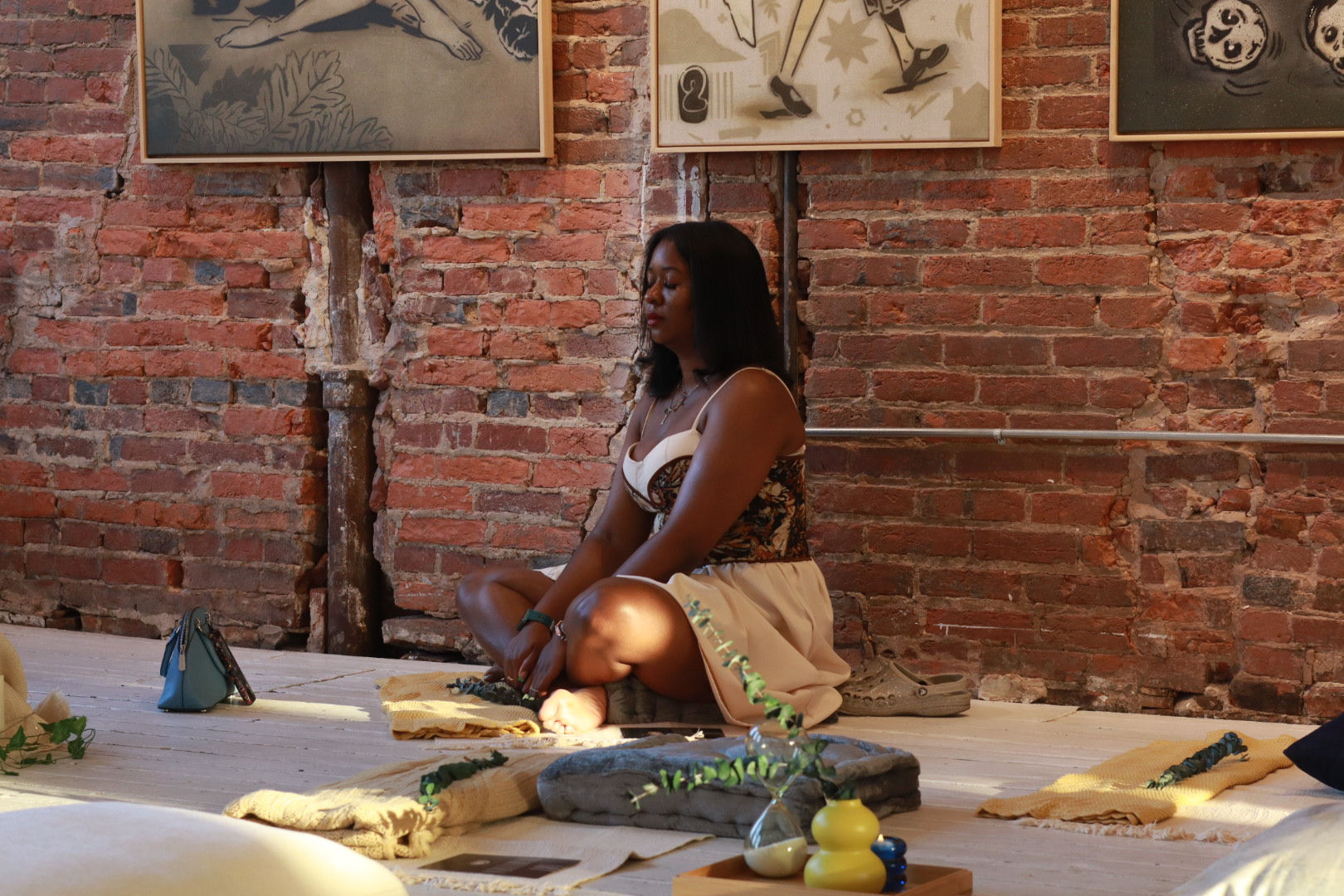
A gallery is one of the few public places where you are encouraged to stop, look, and stay with something for longer than a few seconds.
That makes it an interesting place to practice mindfulness.
Gardens & Galleries: Art & Mindfulness is built around a simple question:
What changes when you look at the same thing from a different state of awareness?
During an Art & Mindfulness experience, we begin by spending time with the exhibition as we are. Participants walk through the gallery, notice what draws their attention, spend time with individual works, and form their own impressions.
There is no instruction about what they should see.
That first encounter matters because it gives us something to return to.
From there, the group comes together for a guided meditation and sound bath designed to slow things down and help settle the nervous system. For a little while, we move away from analyzing the artwork entirely. The focus shifts inward. We breathe, become quieter, notice the body, and allow some of the mental noise we arrived with to soften.
Then we go back into the gallery.
The artwork has not changed.
The lighting has not changed. The artist has not returned to alter the piece. The wall is the same wall.
What changes is you.
And sometimes that is enough to change what you see.
A work you passed quickly the first time may suddenly hold your attention. A color may feel more prominent. You may notice a detail you completely missed. Something that initially made you uncomfortable may begin to feel interesting. You may become curious about why you responded to a particular image the way you did.
Sometimes your opinion of the artwork changes. Sometimes it does not.
The point is not to force a different interpretation. The point is to notice whether your perception shifts when your internal state shifts.
Then we add other people
After the second exploration, we come back together to talk about what we noticed.
That part of the experience is just as important.
You may have spent twenty minutes looking at a painting and formed a clear interpretation of it, only to hear someone else describe something you never noticed.
They saw a relationship between two figures you overlooked.
They interpreted a color differently.
They connected the work to a memory, cultural reference, emotion, or idea that would never have occurred to you on your own.
Nothing about your original observation has to be wrong for theirs to expand it.
Now there is another possibility in the room.
That is where the exercise begins to move beyond art.
What happens when we practice this in real life?
We move through everyday life making interpretations constantly.
We interpret conversations. Facial expressions. Emails. People. Workplaces. Relationships. Neighborhoods. Situations that make us uncomfortable.
And most of the time, we are doing that while carrying whatever state we happen to be in.
We may be tired, overstimulated, defensive, anxious, distracted, frustrated, or simply moving too quickly to notice very much.
Art & Mindfulness gives us a place to practice something different.
Pause.
Notice your first interpretation.
Regulate.
Return.
Look again.
Then, when appropriate, allow someone else's perspective to enter the conversation.
That does not mean abandoning your own judgment. It means becoming aware that your first perception is not always the only perception available to you.
Meditation in solitude is valuable. Sitting quietly, developing awareness, and learning to return your attention are important practices.
But there is another part of the skill: using it while engaging with the world.
Art gives us a surprisingly practical place to practice.
There are no major consequences if you reconsider your interpretation of a painting. That makes the gallery a kind of laboratory where curiosity, attention, regulation, and perspective can be exercised before we need those skills in more complicated situations.
The hope is that eventually the practice follows you out of the gallery.
Maybe you pause before responding to a difficult conversation.
Maybe you notice when stress is influencing the way you are reading a situation.
Maybe you become curious about another person's perspective without immediately deciding that it cancels your own.
Maybe you simply notice more.
Who is Art & Mindfulness for?
You do not need to have a meditation practice or know anything about contemporary art.
For people who already meditate, the experience offers an opportunity to take a familiar internal practice and apply it to something outside yourself.
For art lovers, it creates more time and space to connect with a work, consider what the artist may be communicating, and hear how other people experience the same piece.
For galleries and cultural spaces, it offers another way for visitors to engage deeply with exhibitions while keeping the artwork itself at the center of the experience.
And for people living with demanding schedules, stressful work environments, or simply the pace of everyday life, it creates a place to practice slowing down and observing what happens when you do.
Gardens & Galleries is not about teaching you the correct way to see art.
It is about becoming more aware of how you see.
Because the artwork stays the same.
What changes is you.
Keep reading with us